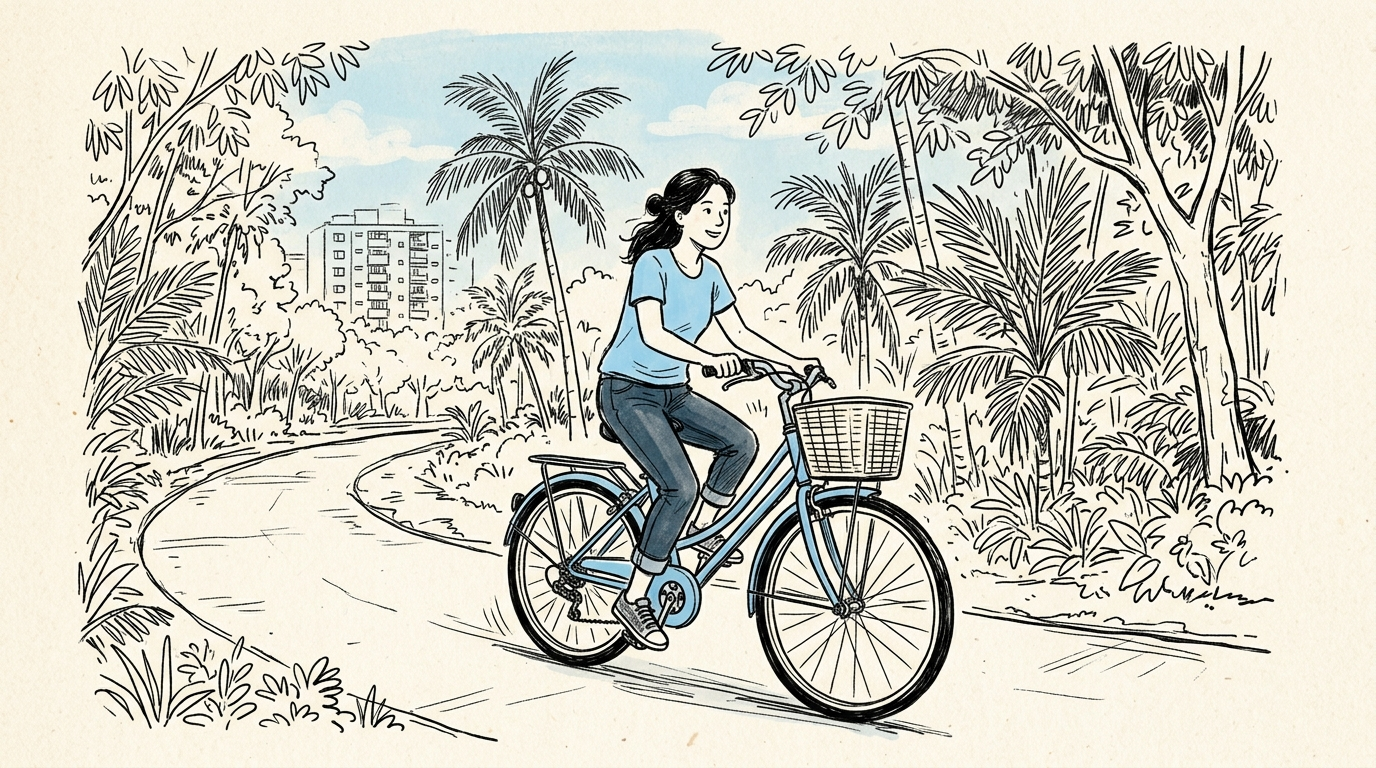
Maybe you grew up somewhere bikes weren't a thing. Maybe your parents didn't ride. Maybe you tried once at seven, fell hard, and the memory stuck. Whatever the reason — about 90% of the adult students we coach are learning to cycle for the first time. The youngest was 4. The oldest was 38.
Here's the truth: the bike doesn't know how old you are. Your body figures out balance the same way it always has — by trying, wobbling, catching itself, and slowly trusting that the wobble is normal. The difference between adult learners and 6-year-olds isn't the physical skill. It's the fear. And the fear, with the right approach, comes off in about thirty minutes.
Why Singapore is actually a great place to learn
People think Singapore is too crowded, too hot, too dangerous. It isn't — if you know where to go.
- Sheltered HDB carparks are gold. Flat, smooth, often empty mid-week, and the shade matters more than you'd guess.
- Park Connector Network (PCN) stretches over 300km. Long quiet stretches at Bedok Reservoir, Pasir Ris Park, East Coast — all flat, all safe.
- Off-peak hours (weekday mornings/afternoons, or weekends after lunch) on quieter PCNs feel like personal training tracks.
You don't need a velodrome. You need a flat surface, an hour, and someone patient.
What to expect emotionally
Adult learners often arrive a little embarrassed. They shouldn't be. Within the first ten minutes, the embarrassment becomes laughter — usually their own, at the wobble. Within the first thirty, the focus shifts from "will I fall" to "wait, am I actually doing this?" That moment is what we coach for.
You're not behind. You're just starting later. Bodies don't keep score.
A few things that help:
- Wear closed-toe shoes that grip the pedal.
- Bring water. Singapore is hot even on cloudy days.
- Don't bring an audience the first time unless they're truly supportive — pressure slows learning.
- Don't try to learn from a friend who already cycles. They've forgotten what it felt like to not know.
How many lessons most adults need
Honest answer:
- Lesson 1 — you'll be riding and balancing on your own, possibly wobbling on turns.
- Lessons 2~3 — you'll feel steady, understanding how to manoeuvre and brake.
- Lesson 4 — you'll handle real-world stuff: turns, light traffic, slopes, riding alongside others.
After that, it's just hours in the saddle. The PCN is your gym.
"I tried before and couldn't do it"
This is the most common story we hear. The fix is almost always the same: someone tried to teach you with the pedals on, the seat too high, on a bike that was the wrong size, on a surface that wasn't flat. None of that was your fault.
Start over with the seat down and a quiet flat carpark. You'll surprise yourself.